
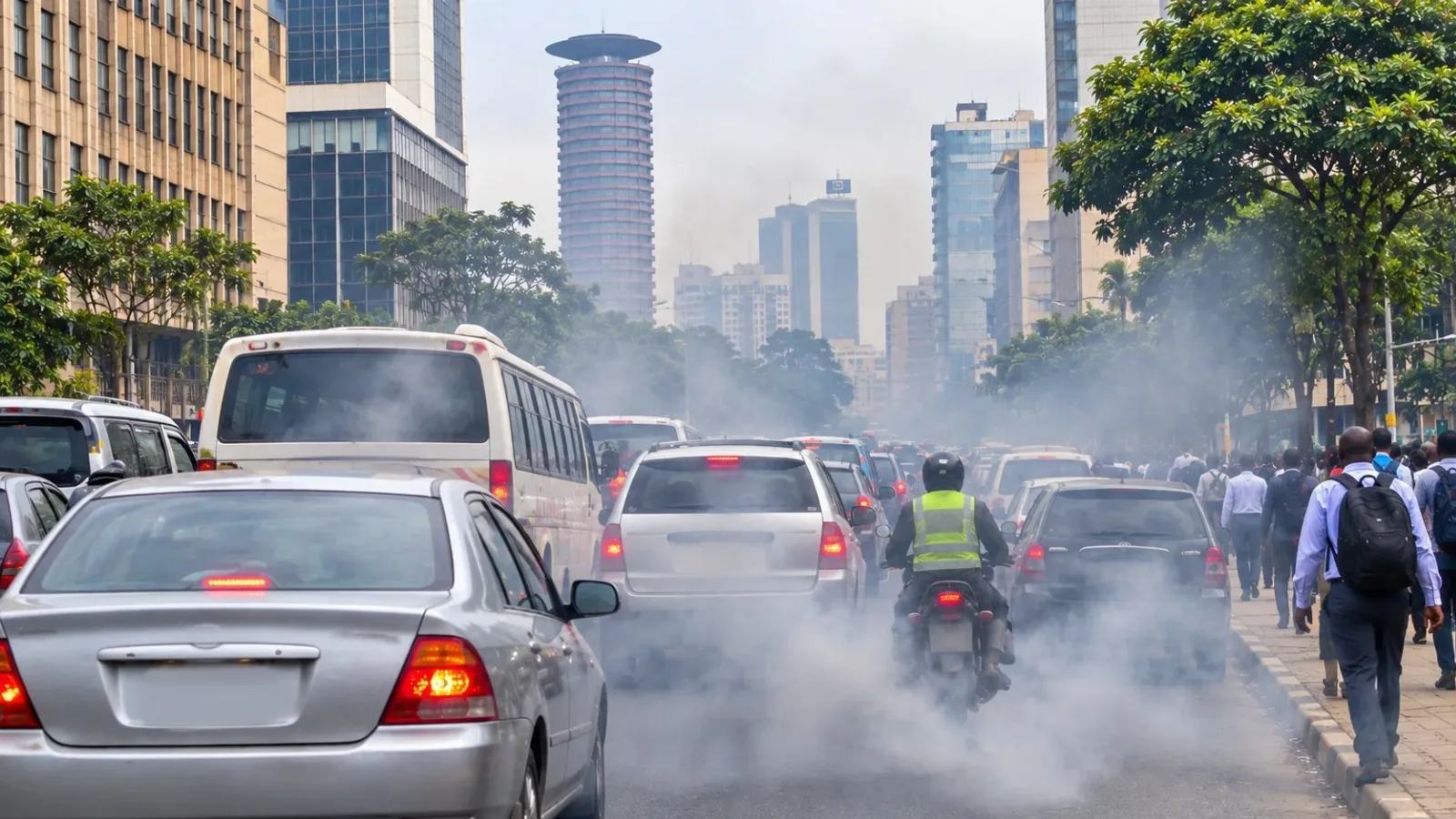
Scientific data from continuous monitoring show that Nairobi’s air is becoming an everyday health concern. From exhaust fumes and sewage odours to dust and garbage, levels of fine particulate matter in the CBD can reach 30 times the World Health Organisation’s recommended daily guideline, raising fears about the respiratory and cardiovascular health of millions of residents.
Back in 2020/21, Covid-19 introduced the world to mask-wearing. As the pandemic subsided, restrictions were lifted and normal life resumed, the expectation was that masks would become a thing of the past.
But walk through Nairobi’s Central Business District (CBD) and you will notice something curious: Many Kenyans still wear masks as they go about their daily business.
For some, it is a precaution against respiratory infections. For others, it is an attempt to shield themselves from the city’s increasingly unpleasant air.
“I struggle with fumes from motor vehicle exhausts,” says Julia Wanja, a smartphone spare parts shop owner along Moi Avenue.
Wanja says the fumes are particularly difficult to contend with as she spends much of her day in the CBD, where vehicles, matatus and motorcycles compete for space with pedestrians.
While she wears a mask to protect herself from exhaust fumes, other Nairobians have different reasons for covering their noses and mouths. They simply cannot stand the strange smells that have become synonymous with particular streets and spaces in the city.
Caroline Ngambu, for instance, has identified several places she would rather avoid because of their smell.
“One is Ronald Ngala Street. Some sections have a very strong sewage odour. Then it is a high-traffic street with lots of petrol fumes. Some sections also have litter and reek of garbage,” she says.
Ngambu also points to instances of open defecation, which she suspects are associated with some members of street families, saying the resulting smell can be unbearable.
“I have a new mask every day because in this city you cannot be prepared for whatever funny smell you are going to encounter wherever you go,” she says.
Her experience is not isolated.
About a week ago, radio personality Sheila Kwamboka, popularly known as Kwambox, took to Instagram to lament the deterioration of Nairobi’s air quality.
“We are taking for granted something granted to us by God,” she said, calling for action to address the situation.
At Ambassadeur, a busy public transport terminus in the CBD, Stacy Moraa has turned the situation into a business opportunity.
A street hawker, Moraa routinely stocks face masks among her wares, selling both blue and black varieties at Sh10 apiece.
“I have both blue and black masks. Going at Sh10 a piece,” she advertises.
Interestingly, she does not wear one herself.
“I am used to the smell,” she explains.
For Moraa, the demand is what matters. She says she can sell almost two packs of masks during a typical 12-hour working day.
“A pack has 50 pieces. Between 7am and 7pm I am usually on the second pack. The demand is there,” she says.
But beyond the smells, masks and individual coping mechanisms lies a much bigger problem: Nairobi’s air contains pollutants that cannot be seen or detected by the human nose, some of which pose serious risks to human health.
Bokayo Jillo, who lives and works in Marsabit but frequently travels to Nairobi, says the difference becomes particularly apparent when she leaves the capital.
“It is only after you leave Nairobi that you can fully appreciate clean air. Nairobi has horrible air quality. I suspect that for many who live in the city they have to stomach it because they are earning a living. But many, for this one reason alone, could make the decision to relocate and head back to the village or somewhere else you can breathe without much struggle,” she says.
Her observations are supported by scientific evidence.
Studies conducted over the past decade have consistently found that Nairobi’s air pollution exceeds recommended health limits. A 2021 study, for instance, found that pollution levels in seven out of the city’s eight planning zones were above World Health Organisation (WHO) guidelines.
More recent monitoring data suggest that the situation in the CBD is particularly concerning.
A collaboration between Nairobi City County Government and the World Resources Institute (WRI) led to the installation of air quality monitoring equipment at Mama Lucy Hospital and Nairobi Fire Station.
The equipment measures pollutants in real time, providing a clearer picture of what residents are breathing.
“The data shows that Nairobi CBD is extremely polluted. At Fire Station we are recording an average of 35 µg/m³ (micrograms per cubic metre of air) for PM2.5,” says George Mwaniki, Head of Air Quality and Kenya Country Representative at WRI Africa.
PM2.5 refers to fine particulate matter measuring 2.5 micrometres or less in diameter. These particles are particularly dangerous because they are small enough to penetrate deep into the lungs and, in some cases, enter the bloodstream.
The WHO recommends that the average daily concentration of PM2.5 should not exceed 15 µg/m³. Its annual guideline is even stricter, at 5 µg/m³.
This means the average reading of 35 µg/m³ recorded at Nairobi Fire Station is more than twice the recommended daily limit and seven times the annual guideline.
And the situation gets worse during rush hour.
When public transport and private vehicles hit the roads in the morning and evening as thousands of people commute to and from work, pollution levels rise sharply.
“During morning and evening rush hours, we are recording highs of 100 µg/m³. In fact, there are a couple of days in the record that show levels up to 150 µg/m³,” Mwaniki says.
At 150 µg/m³, the concentration is ten times the WHO’s recommended daily guideline.
Although the full dataset from the monitoring stations was still being processed at the time of the interview, Mwaniki says the emerging patterns point to motor vehicles as a major source of pollution.
“We are measuring real time. We can compare them against activity. Morning rush hour and evening rush hour is extremely high. That points to vehicles. It is a pattern seen in most cities around the world,” he explains.
The findings are consistent with Nairobi’s Air Quality Action Plan (NAQAP) 2025-2029, which identifies on-road vehicular emissions as responsible for approximately 40 per cent of PM2.5 concentrations in the city’s air.
The plan identifies several factors contributing to vehicle-related pollution, including low-quality fuel, poor vehicle maintenance, inadequate road infrastructure and the absence of effective vehicle emissions regulations.
In 2021, Nairobi had 2,612,335 registered vehicles, accounting for approximately 60 per cent of all vehicles in Kenya.
The problem, however, extends beyond traffic.
Garbage burning and disposal, wastewater, industrial emissions, agricultural activities and household air pollution are among the other contributors to Nairobi’s deteriorating air quality.
The significance of PM2.5 is that, unlike the unpleasant smells that residents complain about, these particles can cause harm even when the air appears clean.
The invisible health threat
The health consequences of prolonged exposure to polluted air are already being documented.
According to Nairobi’s Air Quality Action Plan, long-term exposure to PM2.5 contributed to an estimated 400 to 1,400 premature deaths in Nairobi in 2021.
Dr James Mwitari, Director and Principal Investigator at the Air Pollution Centre of Excellence domiciled at the Kenya Medical Research Institute (KEMRI), says PM2.5 is among the most concerning air pollutants because of its ability to penetrate deep into the human body.
“Of all the pollutants, PM2.5 is the most worrisome. This type of suspended particulate matter is the most dangerous to human health. PM2.5 is very fine and can be absorbed directly into the bloodstream,” he says.
Once inhaled, the particles can penetrate deep into the lungs, with some entering the bloodstream and potentially affecting other organs.
Mwitari says prolonged exposure is associated with a range of health complications, including cardiovascular disease, respiratory illnesses, diabetes, neurological problems and cancer.
The World Health Organisation links air pollution to a significant proportion of deaths from several major diseases.
Its estimates attribute approximately 89 per cent of chronic obstructive pulmonary disease (COPD) deaths, 61 per cent of lower respiratory infection deaths, 63 per cent of lung cancer deaths, 56 per cent of stroke deaths, 49 per cent of ischaemic heart disease deaths and 35 per cent of neonatal deaths to air pollution.
Children are particularly vulnerable.
Last year, the WHO highlighted the contribution of air pollution to childhood pneumonia deaths, estimating that more than half of such deaths are linked to air pollution.
Dr Warurua Mugo, a paediatric pulmonologist who runs clinics at Gertrude’s Children’s Hospital, says polluted air can compromise the respiratory system and make people more susceptible to infections.
“Pollution in the air causes inflammation in the respiratory system. Inflammation leads to wounds that expose affected areas to infections.
“Therefore, children – and adults too – who live in an environment with high air pollution have a higher risk of developing respiratory infections such as pneumonia,” he says.
Mugo says he has observed that patients living in polluted environments tend to suffer respiratory illnesses more frequently than those in areas with cleaner air.
“What I have taken note of is that people living in an area with air pollution have a higher chance of getting sick with respiratory illnesses. They also do get sick more frequently compared to those who live free of the pollution,” he says.
He has also observed referrals involving patients from neighbourhoods experiencing particularly high pollution levels.
Victor Nthusi, a researcher with the US-based Health Effects Institute, says the health consequences of air pollution can be divided into short-term and long-term effects.
Short-term effects occur within days, weeks or months of exposure and may include aggravated asthma, pneumonia, bronchitis and upper respiratory tract infections.
“These are reactions to the pollution that occur within days, weeks and months,” he explains.
Long-term effects, on the other hand, develop after years of exposure and can have more devastating consequences.
“These challenges develop over a long period of time. They don’t kill you immediately, but they incredibly reduce life expectancy. They include illnesses like lung cancer and COPD,” Nthusi says.
The danger, therefore, is not limited to people who experience immediate breathing difficulties. Someone who appears healthy today may be accumulating the effects of prolonged exposure to polluted air.
Not all bad smells are air pollution
There is an important distinction between the unpleasant smells Nairobi residents encounter and the pollutants that pose the greatest health risks.
Sewage odours, rotting garbage and exhaust fumes may all make the CBD unpleasant, but smell alone is not a reliable measure of air quality.
Some hazardous pollutants are odourless, meaning people can be exposed without realising it. Conversely, an unpleasant smell does not automatically indicate that the concentration of a particular pollutant is at a dangerous level.
This makes air quality monitoring particularly important.
The WHO identifies particulate matter (PM2.5 and PM10), carbon monoxide, ozone, sulphur dioxide, nitrogen dioxide and lead among the major air pollutants of concern because of their adverse effects on human health.
For Nairobi, the challenge is to move beyond residents relying on masks, avoiding certain streets or simply getting used to the smell.
The city needs sustained monitoring, stronger vehicle emissions controls, better waste management, improved public transport and enforcement of existing environmental regulations.
For now, the air that millions of Nairobians breathe every day remains an invisible public health concern – one that cannot be solved by holding one’s nose or wearing a Sh10 mask.
And perhaps that is the most unsettling part: You do not have to smell the pollution to be harmed by it.