
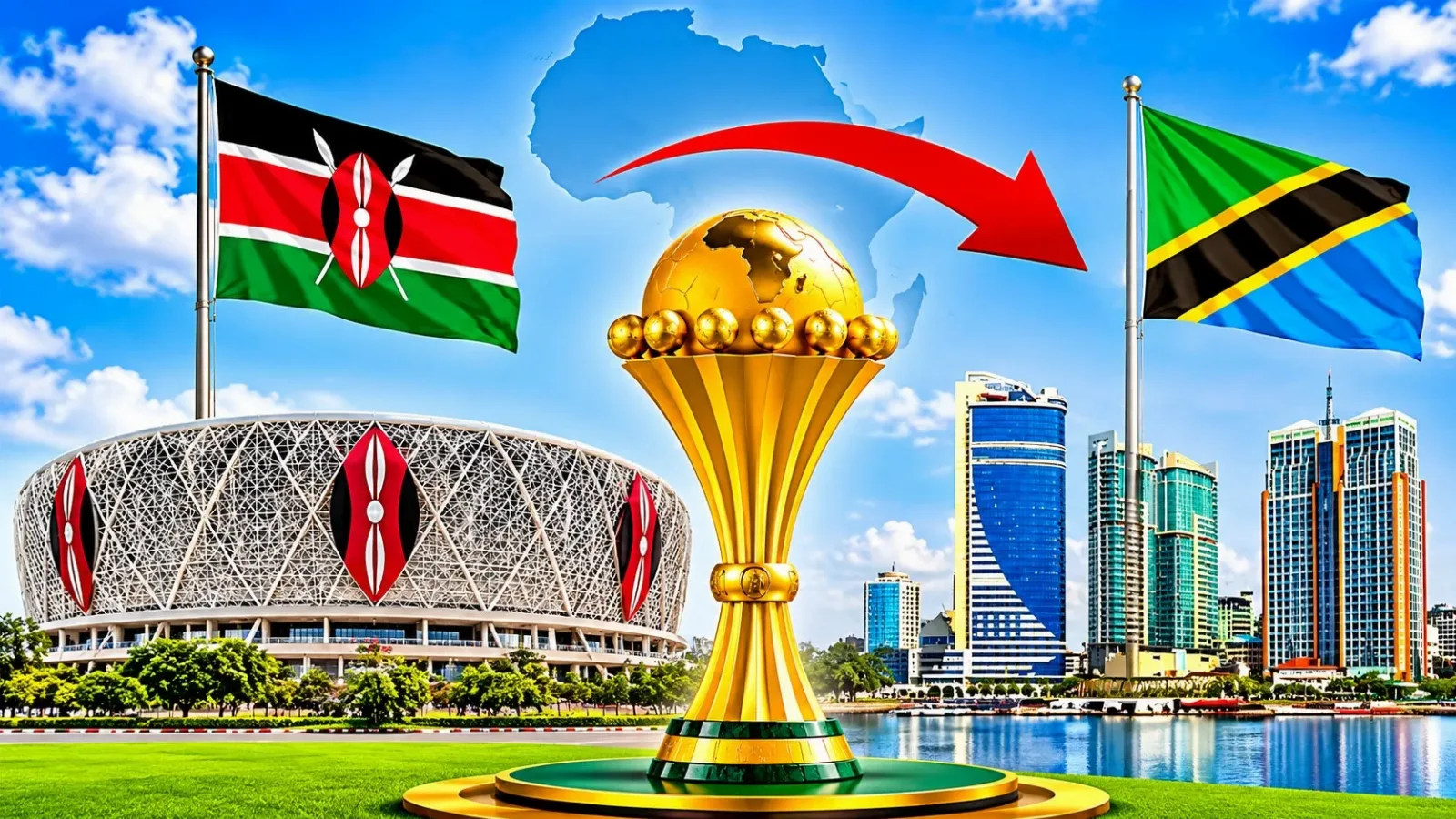
Is the Confederation of African Football (CAF) quietly expressing a lack of confidence in Kenya’s ability to deliver the 2027 Africa Cup of Nations by shifting the tournament’s coordination headquarters from Nairobi to Dar es Salaam?
That is the uncomfortable question confronting Kenyan football following reports that CAF has chosen the Tanzanian commercial capital as the operational nerve centre for the continental tournament, which Kenya is due to co-host with Tanzania and Uganda from June 19 to July 17, 2027.
The reported decision comes at a particularly sensitive moment for Kenya, whose football administration is engulfed in a bitter leadership struggle between Football Kenya Federation (FKF) president Hussein Mohammed and his deputy, McDonald Mariga.
While CAF has yet to publicly explain the reasons behind the reported relocation, the timing is difficult to ignore.
It comes just days after Inflection published an extensive investigation, Kenya’s AFCON 2027 Moment: Can CAF and FIFA Rescue FKF from Itself?, documenting the institutional crisis at Kandanda House and the potential implications for Kenya’s preparations to co-host Africa’s biggest football tournament.
The development raises a fundamental question: Has Kenya’s internal football administration crisis become a liability serious enough to influence where CAF chooses to coordinate the tournament?
Dar takes centre stage, but Kenya disputes relocation
Reports published on November 18 and 19 indicated that CAF was moving its AFCON 2027 coordination operations from Nairobi to Dar es Salaam, with the new office scheduled to be officially launched on November 25.
Tanzania’s AFCON 2027 Local Organising Committee Secretary-General Neema Msitha confirmed the planned launch, saying CAF officials were expected to attend.
The Tanzanian government has reportedly provided office space on the second floor of a building housing a branch of the Ministry of Foreign Affairs and East African Cooperation in the Posta area of Dar es Salaam.
The office is expected to coordinate critical tournament functions, including security, transport, accommodation, logistics, competition management, media and broadcasting.
However, the relocation narrative encountered resistance in Nairobi.
On Thursday, November 20, Local Organising Committee chairman Nicholas Musonye disputed claims that CAF had formally relocated its operations centre, saying no commitment had ever been made to Nairobi as the location of the tournament’s coordination headquarters.
Speaking at a press briefing, Musonye argued that Kenya had no automatic entitlement to host the operations centre simply because Nairobi had served as CAF’s coordination base during the 2024 African Nations Championship (CHAN).
“When we (Nairobi) hosted the CHAN operations centre, it was CAF who decided so. There was no guarantee that they would do the same for AFCON. We are equal partners in this bid, and so there is no big blow for Kenya if the headquarters is hosted by our partner,” Musonye said.
He also insisted that Kenya was on course to meet its tournament infrastructure obligations, maintaining that the country remained capable of hosting its allocated matches.
The FKF crisis that threatens Kenya’s AFCON moment
The timing of the development is particularly significant because of the turmoil within FKF.
As detailed in our November 15 investigation, the federation has been consumed by a bitter power struggle between Mohammed and Mariga, a partnership that collapsed barely 18 months after their election in December 2024.
What began as a dispute over a controversial insurance payment relating to CHAN 2024 escalated into competing claims of authority, investigations into the federation’s financial affairs and a constitutional battle that has drawn the attention of FIFA.
A test of regional cooperation
The 2027 AFCON is historic because it will be the first edition of the tournament jointly hosted by three countries.
The PAMOJA arrangement presents an opportunity for Kenya, Tanzania and Uganda to demonstrate the possibilities of regional cooperation and showcase East Africa as a competitive destination for major international sporting events.
But the success of such an undertaking depends on mutual confidence, effective communication and an equitable distribution of responsibilities.
If Dar es Salaam becomes the principal coordination centre, that does not automatically mean Kenya has lost its hosting rights or that Tanzania will necessarily receive the opening match or final.
All three countries remain co-hosts and must deliver their respective obligations.
However, the symbolism of the reported decision cannot simply be dismissed, particularly when Kenya is battling an institutional crisis within the very federation expected to play a central role in football preparations.
It is also worth remembering that CAF and FIFA are not strangers to Kenyan football’s governance problems. Both organisations have already been drawn into the dispute between Mohammed and Mariga.
The question now is whether the latest development will prompt a more serious examination of the institutional weaknesses threatening the country’s preparations. The tournament requires a functioning football federation, credible leadership, accountable financial management and effective cooperation between all the institutions involved.
And if the decision has nothing to do with Kenya’s governance challenges, CAF should have little difficulty explaining the operational considerations behind it.
The question is no longer simply whether Kenya can build the stadiums. It is whether it can put its football house in order before the continent arrives.