The education promise is under threat: When poverty begins to determine who gets ahead
In Part 1, The Betrayal of the Hustler, we examined how the promise of economic liberation gave way to mounting financial pressures on ordinary Kenyans. In Part 2, The War on Gen Z, we examined how the government’s response to a generation demanding accountability exposed a deepening crisis of public trust. Now, in the third instalment of this seven-part series, we turn to education – once Kenya’s most dependable instrument of social mobility, but increasingly threatened by inadequate planning, funding shortfalls and policies that risk making a child’s future dependent on the financial circumstances of their parents.
For generations, Kenyan parents have made extraordinary sacrifices to educate their children. They have sold livestock, mortgaged land, borrowed money and gone without basic necessities to ensure their sons and daughters get an education.
Their motivation has been remarkably consistent across social and economic backgrounds: Education offers the possibility of a better life.
A child born into poverty can become a doctor, engineer, teacher, entrepreneur or public servant. A family with limited resources can invest in education and hope that the next generation will enjoy opportunities that were unavailable to its parents.
Education has therefore been more than a public service. It has been one of the most powerful instruments of social mobility and a central pillar of Kenya’s social contract.
But under the Ruto presidency, that promise faces an uncomfortable question: Is education becoming a privilege increasingly determined by a family’s ability to pay?
The warning signs are difficult to ignore.
The implementation of the Competency-Based Education (CBE) has exposed serious weaknesses in the country’s education infrastructure, funding and planning. What was presented as a transformative overhaul of the education system has encountered the familiar problem of ambitious policy promises unsupported by adequate institutional preparation.
The transition to Junior Secondary School required additional classrooms, laboratories, learning materials and appropriately trained and deployed teachers.
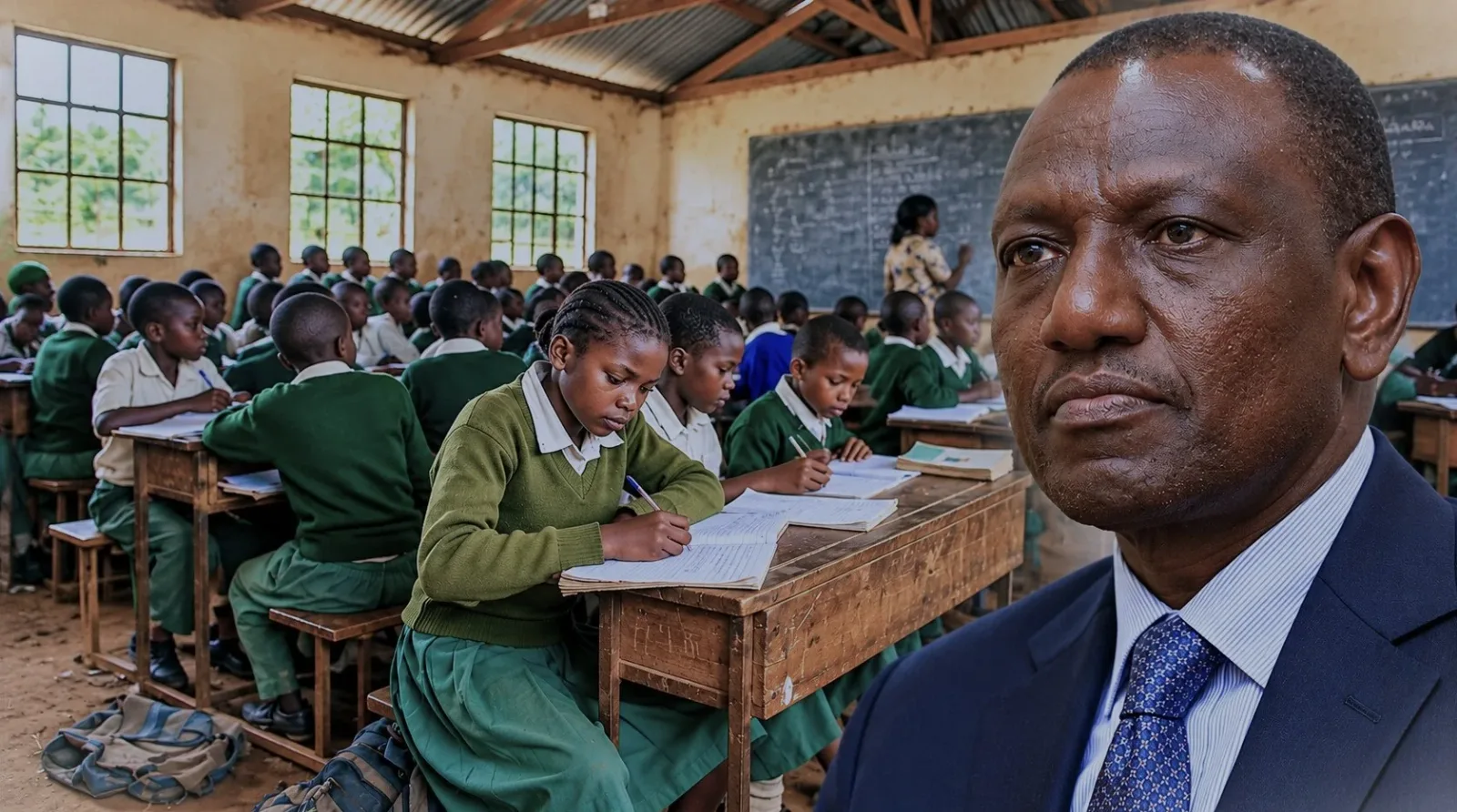
Yet many schools, particularly in rural and economically disadvantaged communities, struggled to provide the facilities required to implement the new curriculum.
Parents were confronted with additional expenses, teachers complained about inadequate resources, and the widespread reliance on intern teachers became a contentious issue.
The problem is not that Kenya needs education reform. The previous system had legitimate shortcomings, and a curriculum that encourages practical competencies, creativity and critical thinking has considerable merit.
The problem is that reform without adequate preparation, funding and consultation does not eliminate institutional weaknesses. It transfers their cost to schools, teachers and parents.
In effect, families are being asked to finance the consequences of failures in public planning.
The university funding model has exposed an even more fundamental contradiction.
Introduced in 2023, the differentiated funding framework was intended to allocate government scholarships and student loans according to the assessed financial circumstances of individual students.
The government’s argument was that scarce public resources should be distributed according to need rather than through a uniform system that failed to adequately distinguish between wealthy and disadvantaged households.
In principle, this was a reasonable objective. Public resources should prioritise those who need them most.
But a progressive policy objective does not automatically produce a fair outcome.
The means-testing process generated serious concerns about the accuracy of household assessments, the adequacy of student support and the financial contributions expected from families. Students and parents questioned how their household circumstances were assessed and whether the resulting allocations reflected their actual ability to pay.
The controversy eventually reached the courts.
On December 20, 2024, the High Court declared the university funding model unconstitutional, finding that its implementation violated students’ legitimate expectations and had failed to meet constitutional requirements, including adequate public participation.
The Court of Appeal subsequently stayed the High Court orders on March 26, 2025, allowing the funding model to continue pending further proceedings.
But the legal contest has not resolved the underlying policy dilemma.
What happens when a bright student from a poor household receives a funding allocation that their family cannot afford to supplement?
What happens when the cost of university education becomes a barrier to completing a degree?
And what happens when public universities themselves struggle to finance operations, meet obligations to suppliers and maintain the quality of teaching?
These are not abstract policy questions. They determine whether education continues to function as an instrument of social mobility or gradually becomes another mechanism through which inherited inequalities are reproduced.
A funding model that recognises financial vulnerability in theory but fails to adequately protect vulnerable students in practice risks defeating its own purpose.
The consequences extend beyond individual students. When university education becomes financially inaccessible to talented young people, the country loses future professionals, innovators, researchers and entrepreneurs. The economic cost of exclusion is borne not only by affected families but by the nation itself.
The government must also recognise that household financial difficulties cannot be separated from the wider economic environment.
As we observed in the first instalment of this series, ordinary Kenyans are already contending with mounting taxation, rising living costs, expensive transport and competing household demands.
For such families, additional education-related expenses are not minor inconveniences. They can determine whether a child remains in school, progresses to the next level or abandons the prospect of higher education altogether.
The stakes are particularly high for children from informal settlements, marginalised communities and rural households.
For these children, public education is often the only realistic pathway to opportunities beyond the economic circumstances into which they were born.
When that pathway becomes unreliable or unaffordable, poverty ceases to be merely a condition of the present. It becomes an inheritance passed from one generation to the next.
This is why the administration must be judged on more than the number of teachers recruited, classrooms constructed, students registered or funding models announced.
The real test is whether every Kenyan child, irrespective of family income or geographical location, has a fair opportunity to receive quality education and progress to the next level.
It is whether a child from Turkana has the same meaningful opportunity to realise their potential as one from an affluent Nairobi neighbourhood.
It is whether a bright student from a low-income household can enter university, complete a degree and pursue a career without their family’s financial limitations determining the outcome.
And it is whether government education policies are designed around the needs of learners or the convenience of public administration.
The cardinal sin is allowing ambitious education reforms to outpace the funding, infrastructure, consultation and institutional capacity required to make them work.
It is the failure to appreciate that education is not simply another government programme whose success can be measured through announcements, budget allocations and administrative statistics.
It is a national investment in human potential, economic productivity and social equality.
A government that makes education less accessible to its poorest citizens risks dismantling one of the few institutions capable of breaking the cycle of inherited poverty.
The hustler economy promised that one’s circumstances at birth would no longer determine one’s destiny. But if a child’s educational prospects increasingly depend on the wealth of their parents, that promise begins to ring hollow.
A country that makes poverty the price of a poor education, and wealth the passport to a better one, is not building an equal society. It is institutionalising inequality.
And that would be one of the most consequential betrayals of the bottom-up promise.
Tomorrow: The Healthcare Gamble