
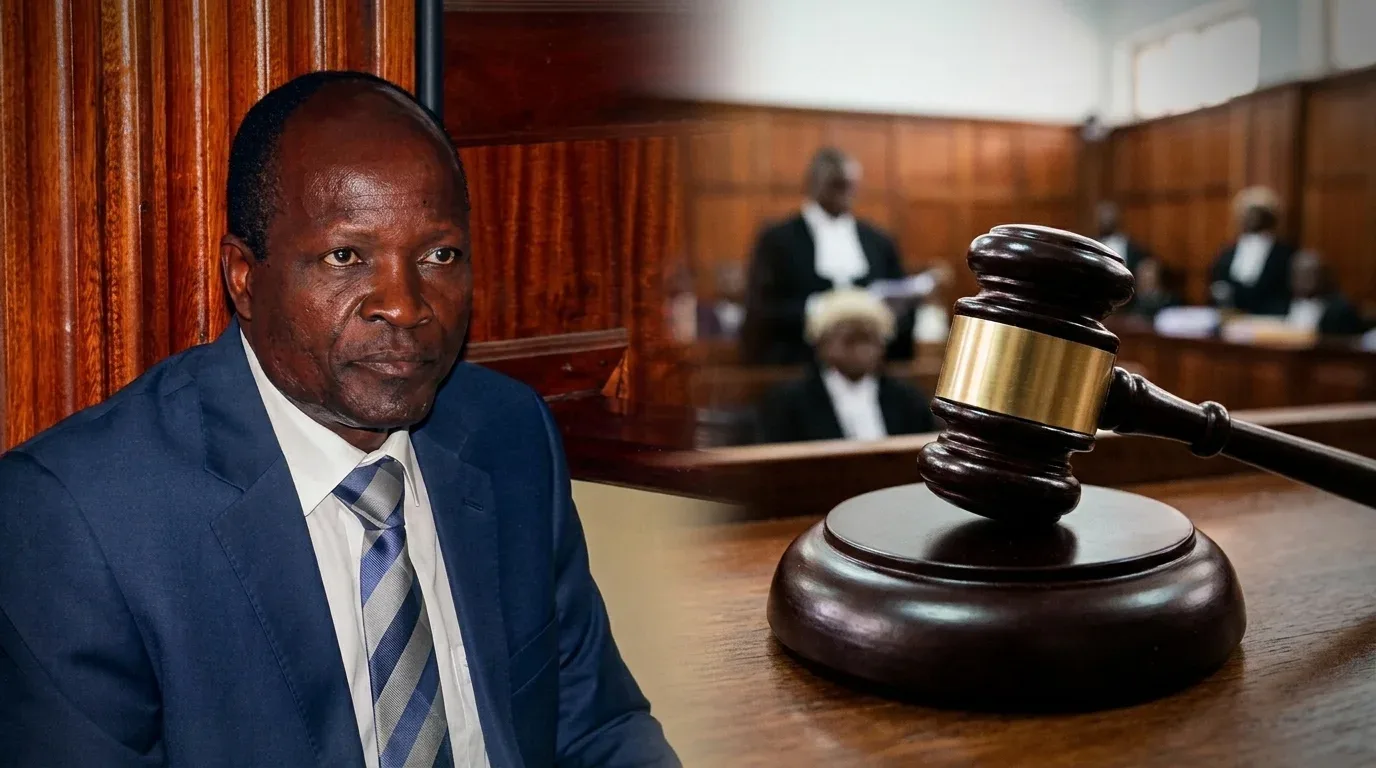
There are moments in a country’s history when a court judgment becomes something bigger than the legal dispute that occasioned it. The sentencing of former Migori Governor Okoth Obado to 25 years in prison for the murder of Sharon Otieno may well be one such moment.
It is, first and foremost, a moment of profound sadness. A young woman, Sharon Otieno, lost her life in circumstances of extraordinary brutality. She was 26, a university student, a mother and seven months pregnant. Her unborn child died with her. No prison sentence can restore either life. No judgment can return to her children the mother they lost.
But the sentence also carries a message that extends well beyond the courtroom at Milimani. It speaks to the relationship between power and accountability in Kenya. And it raises a question that every powerful person in this country ought to consider: Is the era in which wealth, political connections and influence could be deployed to escape the consequences of one’s actions finally beginning to come to an end?
Kenya has for a long time operated with an uncomfortable hierarchy of justice. The poor and powerless have often experienced the law as an unforgiving instrument, while the rich, politically connected and influential have sometimes appeared to enjoy a different relationship with it.
We have seen powerful people summon the best lawyers, deploy political networks, mobilise public sympathy and use their considerable resources to frustrate accountability. Some have managed to turn their legal troubles into political contests. Others have made the passage of time itself their most effective defence.
This is why the Obado case is so significant. Here was a man who had occupied one of the most powerful elective offices in the country. He had money, political connections and considerable influence. He had access to the best legal representation. His case attracted enormous public attention, and the trial went on for years.
Yet, after all that, he was convicted and sentenced to 25 years in prison.
Even more striking is what happened at sentencing. Sharon’s family, having endured years of grief, asked the court to consider a non-custodial sentence so that Obado could continue supporting the children Sharon left behind. There was an appeal to the court’s humanity, and an expression of forgiveness and reconciliation.
The family was entitled to make that appeal. Its suffering is not something outsiders should presume to understand or judge. Indeed, one can appreciate the terrible dilemma facing a family trying to secure a future for children who have already lost so much.
But the court drew an important distinction: Forgiveness and financial support cannot substitute for accountability for a serious crime.
Justice Cecilia Githua rejected the request, warning against creating a precedent in which people convicted of grave offences could effectively buy their way out of appropriate punishment through financial assistance to victims’ families. That was an important statement about the equality of citizens before the law.
It is tempting to describe this as the beginning of a revolution. Perhaps that is precisely what it is: Not a revolution of the streets, but a gradual revolution in the expectations of citizens about what powerful people can and cannot get away with.
Of course, one judgment does not establish a new culture of accountability. Obado has indicated that he intends to appeal both his conviction and sentence, and he retains his constitutional right to do so. The appeal process must be respected.
But the message of this moment should not be lost. Holding high office should not mean holding a licence to escape justice.
There is another dimension to Obado’s fall that makes it particularly instructive: The extraordinary impermanence of political power. There was a time when Okoth Obado was a formidable political figure in Luo Nyanza. He was not simply another governor in a region where political loyalties have historically revolved around Raila Odinga, popularly known as Baba.
In 2013, Obado accomplished something politically remarkable. He defeated the ODM candidate in Migori and became the only governor in Luo Nyanza elected on a party other than ODM. He did so on a People’s Democratic Party (PDP) ticket, demonstrating that even the formidable political influence of Raila Odinga could be challenged.
For a politician in that political environment, this was no small achievement. Obado could stand his ground. He could look Baba in the eye, so to speak, and demonstrate that he had an independent political constituency. He had the money, the mobilisation machinery and the confidence that came with electoral victory. He was a man whose political calculations could not simply be dictated by the prevailing political establishment.
He would subsequently return to ODM and win a second term. His political stature was substantial.
But look at where he is today. The man who once commanded a county, negotiated political alliances and occupied an influential place in the politics of the region is now a convicted prisoner, serving a 25-year sentence, subject to the outcome of his appeal.
This is not an invitation to gloat over another human being’s misfortune. There is nothing edifying about celebrating someone’s incarceration, particularly in a case involving such terrible human loss. It is, rather, a reminder of a fundamental truth that politicians frequently forget: Power is borrowed, not owned.
An election victory is temporary. A political alliance can dissolve. Friends who once crowded around a powerful man can discover other interests. Wealth can provide extraordinary comfort and opportunity, but it cannot purchase permanence. The office of governor – even president for that matter - however powerful it may appear, is ultimately an office held for a limited period. The individual who occupies it is still subject to the same laws as the ordinary citizen.
Perhaps the greatest lesson of Obado’s trajectory is that political invincibility is often an illusion. The very people who once appeared untouchable can find themselves confronting the consequences of decisions made when they believed themselves to be beyond reach.
There is a particular irony in watching a man who once exercised considerable political independence discover the limits of personal power before the institution of the law.
And yet, even in a moment of accountability, there must be room for humanity. Obado is a human being. He is a father, a member of a family and a man whose life has taken a devastating turn. Twenty-five years in prison is an enormous punishment. Whatever one thinks of his conviction, one should not wish him a life devoid of dignity, reflection or the possibility of moral renewal.
Hopefully, he finds redemption in prison. Hopefully, the years ahead offer him the opportunity to confront the gravity of what the court has found him responsible for, to reflect on the life that was taken, on the children who must grow up without their mother, and on the consequences of the choices that brought him to this point.
Redemption, however, must begin with an honest reckoning. It cannot be manufactured through public relations, financial gestures or the invocation of forgiveness. It requires an acknowledgement of the human consequences of one’s actions and a willingness to confront them.
And perhaps this is where the story has its most important message for Kenya’s current crop of leaders, wealthy individuals and people who occupy positions of influence: Do not wait until the dirt hits the fan to begin thinking about redemption.
Do not wait until the police come knocking, the lawyers are on television, the political friends have deserted you and your name has become a national conversation before you begin asking yourself whether you have lived responsibly.
Do not confuse the ability to hire expensive lawyers with the ability to erase wrongdoing. Do not confuse the willingness of people to surround you with loyalty with a guarantee that they will always be there. And, certainly, do not confuse the capacity to give money with the ability to purchase forgiveness or immunity. The best time to do the right thing is when you still have the freedom, influence and opportunity to do it.
For leaders, this means governing with integrity, respecting the lives and dignity of others, and understanding that public office is a responsibility rather than personal property. For the wealthy, it means recognising that money brings obligations, not exemption from the rules that govern everyone else.
For all of us, it means understanding that the measure of a person’s life is not how many people they can command, how much wealth they accumulate or how many powerful people answer their calls. It is also about what they do with the power and opportunities entrusted to them.
The sentencing of Okoth Obado will not, by itself, transform Kenya. There are still powerful people who believe that accountability is something that happens to other people. There are still families who have lost loved ones and who are waiting for justice. There are still cases in which the machinery of justice moves painfully slowly.
But something important has happened: A former governor, once a towering political figure, has been sentenced to a lengthy prison term after a court found him guilty of murder. His wealth, political history and the appeals for leniency made on his behalf did not persuade the court to impose a non-custodial sentence.
That should give hope to ordinary Kenyans. It should also make powerful Kenyans uncomfortable, and perhaps that is not such a bad thing. The ultimate lesson is not that the mighty must fall. It is that the mighty are not above the law. And that is the foundation upon which a just society must be built.
For Sharon Otieno, the sentence cannot undo the terrible loss. Her children will still have to grow up with an absence that no judgment can fill. Her family will continue to carry a burden that no passage of time can entirely erase. May they find peace, and may Sharon’s memory – in Kenya’s socio-political context – remain larger than the circumstances of her death.
And may Obado, in the long and difficult years ahead, find a way to confront his past and seek redemption.
For the rest of us, especially those who wield power today, the lesson is both simple and urgent: Do not wait until you have lost everything to discover the value of living right.