
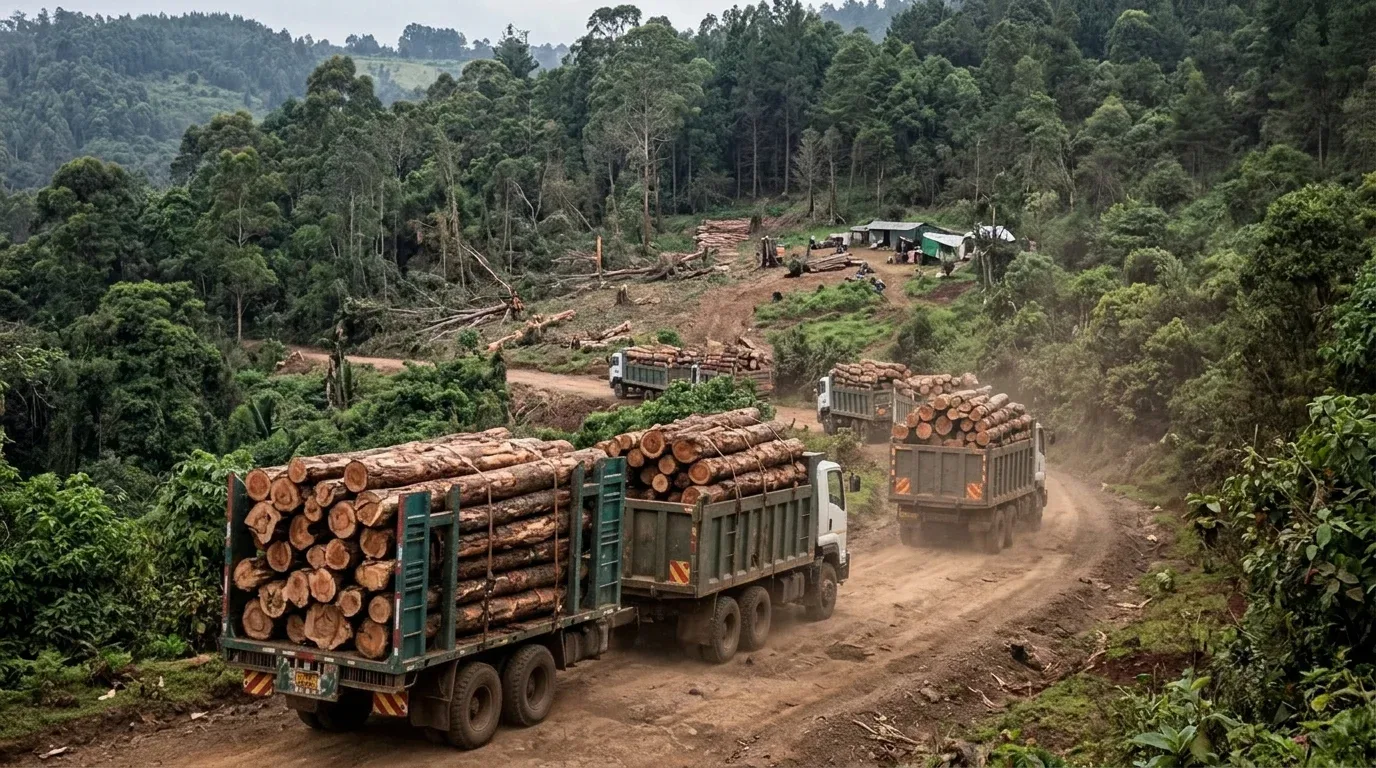
A truckload of mature timber rolls out of the forest. Somewhere downstream, a stream runs thinner. A farmer worries about the next planting season. A community wonders why the trucks keep coming but the benefits never seem to arrive.
These are not disconnected stories. They are different sides of the same climate crisis unfolding in Kenya’s forests.
On October 14, Kipipiri Member of Parliament (MP) Hon. Wanjiku Muhia made an intervention that brought the controversy over logging in the Aberdare Forest into sharp public focus. In a dramatic roadside confrontation, she pulled over a truck loaded with timber. Across her forehead was a green headscarf bearing a simple but powerful message: Save Aberdare Forest.
Together with some of her constituents, she subsequently went to court seeking orders to stop logging in the forest.
The political theatre was hard to miss. But beneath the spectacle was a question that deserves far more than political attention: What happens when the commercial exploitation of forests begins to undermine the ecological systems that sustain millions of lives?
And, perhaps more importantly, who gets to decide how much forest Kenya can afford to lose?
For the government, the answer appears straightforward: There is no illegal logging taking place.
“Illegal logging is not happening in this country; all that is happening is legal and very well planned,” Principal Secretary (PS) for the State Department for Forestry, Gitonga Mugambi, told this publication when questioned about the matter.
But legality and sustainability are not necessarily the same thing. Nor does a government stamp automatically guarantee that an activity is in the best interests of the environment or the communities that depend on it.
The numbers tell a more complicated story.
Latest data from the Kenya National Bureau of Statistics (KNBS) show that between 2019 and 2024, approximately 218,424 hectares of forest were lost through deforestation. Over the same period, afforestation was undertaken on 342,427 hectares.
At face value, this appears to be good news. Kenya planted more forest area than it lost, registering a net gain of approximately 124,003 hectares.
But hectares alone do not tell the whole story.
A hectare of newly planted, young trees is not ecologically equivalent to a hectare of mature forest. Forests are not simply collections of tree trunks that can be removed today and replaced tomorrow. They are complex living systems, built over decades, sometimes centuries, supporting biodiversity, regulating water flows, storing carbon and sustaining livelihoods.
When KNBS measured the changes in biomass - essentially the total weight of living organic material, including trees - a much bleaker picture emerged.
Deforestation between 2019 and 2024 resulted in the loss of approximately 20.19 million tonnes of biomass. Afforestation, meanwhile, added only 1.99 million tonnes.
That leaves Kenya with a net biomass loss of approximately 18.2 million tonnes.
In other words, while the country may be gaining ground in the number of hectares under tree cover, it is losing far more in the actual substance and ecological wealth of its forests.
This is where the national conversation about logging diverges sharply. For the government, the emphasis is on planned harvesting, timber production, jobs and replanting. For conservationists, the concern is that the ecological value being destroyed cannot simply be recreated by planting seedlings.
Elizabeth Wathuti, environmentalist and founder of Green Generation Initiative (GGI), argues that the debate must move beyond whether trees are exotic or mature, or whether a forest has been designated a commercial plantation.
“The concern over tree felling in the Aberdare forest and other critical water towers goes beyond whether the trees are exotic or mature. It is about the future of these landscapes. Calling an area a commercial plantation should not place its future beyond question. These plantations occupy ecologically sensitive parts of our water towers. These catchments sustain rivers, farms, livelihoods and water supplies. Their benefits reach far more people and extend well beyond the returns from timber. Their management must put those functions first,” she says.
It is an argument rooted in climate justice: Forests are not merely economic assets belonging to the state or sources of raw materials for industry. They are life-support systems whose benefits extend far beyond the boundaries of the land on which the trees stand.
When the forest loses weight, the country loses wealth
The economic cost of forest destruction is also substantial, although conventional accounting often fails to capture the full extent of the damage.
According to KNBS, applying the 2019 Intergovernmental Panel on Climate Change (IPCC) guidelines to calculate carbon dioxide equivalent emissions from biomass depletion, Kenya lost an estimated Sh48.05 billion in forest wealth between 2019 and 2024.
The valuation applies a carbon price of US$10 (approximately Sh1,300) per tonne of carbon dioxide equivalent.
But even this figure does not capture everything forests provide. What price can be placed on a disappearing stream, a degraded water catchment, declining biodiversity or a farmer’s increasing vulnerability to drought?
The timber may generate revenue, sustain businesses and provide employment. But the environmental bill does not necessarily land with the companies harvesting the trees. It is often transferred to ordinary Kenyans: Households struggling to access water, farmers facing unreliable rainfall, communities losing ecosystem services and future generations inheriting a more degraded environment.
That is the injustice at the heart of the logging debate.
Recent amateur footage recorded by citizen journalists has added urgency to these concerns. Videos circulating on social media show long lines of trucks loaded with mature logs leaving Geta Forest station in Nyandarua County.
KNBS is yet to quantify the additional tree-cover losses since 2024. Nevertheless, the scale of degradation acknowledged by the government itself is sobering.
Speaking at an event to launch the Kenya Watershed Services Improvement Project (KEWASIP), PS Mugambi said:
“We have a total of about 38 million hectares at various stages of degradation. Out of this, 10.6 million hectares is severely degraded.”
The 38 million hectares represent close to 66 per cent of Kenya’s total landmass.
It is an alarming admission. A country whose economy, food production and water security depend heavily on natural resources cannot afford to treat environmental degradation as a peripheral concern.
Yet, in explaining the problem, the PS appeared to place considerable emphasis on the activities of ordinary Kenyans who depend on forest resources for their livelihoods.
“Sometimes they do things which are not very good. But with alternative incomes, with alternative ways of earning their living, then we will have less and less of this degradation,” he quipped.
There is an important point here: Poverty can drive unsustainable exploitation of natural resources, and communities need viable economic alternatives. But the climate justice question is whether responsibility for forest degradation is being fairly distributed.
If the state insists that commercial logging is legal, properly planned and necessary for economic development, how does it account for the degradation happening on such a vast scale? And why should communities struggling to make a living bear the blame while commercial activities are largely defended on the grounds of legality?
The five per cent question
Mugambi maintains that logging is confined to planted forest plantations, which account for five per cent of Kenya’s forests. The remaining 95 per cent, he says, consists of indigenous forests, where logging is not taking place.
His defence is based on the argument that plantations were established specifically to supply timber, reduce pressure on natural forests, sustain jobs and support local industries.
“They are planted in order to provide timber for this country. Five per cent of all our forests are areas that we have plantations; 95 per cent are indigenous forests. No logging is happening in the indigenous forests. The five per cent is where we are logging in order to provide timber for this country, sustain jobs, sustain industries, and move the country forward.
“We log and we plant. After 25 to 30 years, we log again. In any case if we don’t log these areas, those trees go to waste. And when they go to waste, Kenyans start importing timber. Why should Kenyans import timber when we have our own timber which we have planted for the purpose of providing timber to this country? So, some of the noise we hear is displaced noise.”
The argument raises legitimate questions about Kenya’s timber needs, domestic production, employment and the management of commercial plantations. There is a case for sustainably managed plantations reducing the demand for timber from natural forests.
But the challenge is ensuring that the designation of a plantation does not become a licence to overlook its wider ecological significance.
A commercial plantation located within a sensitive water catchment does not exist in isolation. Its management can affect the water systems, biodiversity and livelihoods around it. Replanting after harvesting may restore some tree cover, but it does not immediately restore the ecological functions of mature forests.
The question, therefore, is not simply whether the trees were planted for timber. It is whether harvesting them, at the scale and in the locations proposed, is compatible with the long-term health of the ecosystems on which Kenyans depend.
The people paying the price
For communities living around Geta Forest, the benefits of commercial logging appear increasingly difficult to reconcile with its costs.
James Matoro, a resident of the area surrounding the forest, told journalists that local people were seeing little apparent benefit from the timber business.
“All we see are trucks and lots of logging activities. It does not seem well planned. Instead of their activities helping locals they are detrimental. The road is unusable now because of the trucks,” he said.
His concerns go beyond the condition of a road. They touch on a fundamental question of environmental justice: If forests are being exploited in the name of national economic development, what is the return for the communities living alongside them?
The governor of Nyandarua County has also expressed concern about water availability, noting that streams are drying up, partly because of wanton logging.
For these communities, forest degradation is not an abstract environmental debate or a distant warning about global warming. It is experienced through unreliable water supplies, damaged infrastructure, threatened livelihoods and growing uncertainty about the future.
Globally, the dependence on forests is enormous. A 2011 United Nations report estimated that at least 1.6 billion people rely on forests for their livelihoods.
Forests also provide habitats for countless species of fauna and flora. Their biodiversity supports interconnected ecological processes, while their vegetation helps regulate local temperatures, rainfall patterns and water cycles.
Their role in tackling climate change is equally indispensable.
Trees absorb carbon dioxide from the atmosphere, storing carbon in their trunks, branches, roots and surrounding soils. When forests are cleared or degraded, much of that stored carbon can be released into the atmosphere, adding to the greenhouse gases driving global warming.
The World Wildlife Fund (WWF) estimates that tropical forests store more than 228 gigatonnes of carbon - approximately seven times the amount emitted annually by human activities.
Destroying forests, therefore, means undermining one of the planet’s most important natural defences against climate change.
Kenya’s water towers are bearing the heaviest losses
The KNBS figures reveal another troubling dimension of the crisis: Kenya’s montane forests account for the largest share of the country’s forest-related economic losses, approximately 68 per cent of the national total.
Montane forests are forests found in mountainous and high-altitude areas, where cooler temperatures, rainfall and unique ecological conditions support specialised plant and animal life. In Kenya, these include the Mau Forest, Mount Kenya, the Aberdares and the Cherangany Hills.
These forests are particularly important because they form part of the country’s major water towers. They capture rainfall, help regulate water flows, replenish rivers and sustain water supplies for households, agriculture and industries.
Their destruction has consequences that travel far beyond the mountains.
When catchment forests are degraded, the country risks reduced water retention, increased soil erosion, sedimentation in rivers and reservoirs, and greater vulnerability to drought and flooding. Farmers downstream, urban households, businesses and entire ecosystems can ultimately pay the price.
The fact that these montane forests account for 68 per cent of Kenya’s forest-related economic losses should therefore be a wake-up call.
The stakes are not confined to timber revenues or the commercial value of harvested trees. They involve the resilience of the country’s water systems and the security of millions of people.
Planting billions of trees is not enough
Kenya has made ambitious commitments to reverse forest degradation.
President William Ruto’s 2022 manifesto pledged a 15 billion Tree Growing Initiative, an ambitious undertaking intended to increase tree cover and restore degraded landscapes.
PS Mugambi says that 2.1 billion trees have already been planted over the last three and a half years.
Corporate participation is also growing. On October 27, telecommunications giant Safaricom published its Environmental, Social and Governance (ESG) report, highlighting restoration initiatives in two degraded forests: Bahati in Nakuru County and the Kuresoi/Sirikwa block in Kericho County.
During Financial Year 2025/26, the initiative resulted in 681,240 trees being planted across 676 hectares.
These efforts demonstrate that forest restoration is possible and that government, businesses and other stakeholders can contribute to the recovery of degraded landscapes.
But Kenya must be careful not to confuse planting targets with ecological recovery.
The KNBS biomass figures demonstrate precisely why. More than 20 million tonnes of biomass were lost between 2019 and 2024, while afforestation added less than two million tonnes.
A newly planted seedling cannot immediately replace the carbon storage capacity, biodiversity, water-regulating functions and ecological complexity of a mature forest. Nor can a tree-planting campaign compensate for continued degradation of sensitive catchments.
Conservationists warn that replenishing the lost biomass will take years, if not decades.
Restoration must therefore go hand in hand with protecting existing forests. Otherwise, Kenya risks running an environmental treadmill: Planting trees with one hand while losing mature forest wealth with the other.
Whose development, whose forests, whose future?
The debate over logging in Aberdare and other critical forest ecosystems ultimately exposes a difficult contradiction in Kenya’s development agenda.
The country wants to expand its economy, support industries, create jobs and reduce timber imports. These are legitimate development priorities. But it also wants to build climate resilience, secure its water resources, protect biodiversity and restore degraded landscapes.
These ambitions cannot be pursued as though they are unrelated.
Legal logging is not automatically sustainable logging. Tree planting is not automatically forest restoration. And economic growth cannot be considered development if the environmental costs are simply passed on to vulnerable communities and future generations.
The people living around Geta Forest should not have to contend with damaged roads, disappearing streams and uncertain livelihoods while being told that the timber industry is moving the country forward. Nor should the value of Kenya’s water towers be reduced to the commercial value of the trees growing in them.
There is a need for greater transparency about where logging is taking place, the ecological assessments informing harvesting decisions, the quantities of timber being extracted, the benefits reaching surrounding communities and the effectiveness of replanting programmes.
Communities must also have a meaningful voice in decisions affecting the ecosystems on which their livelihoods depend.
The green headscarf bearing the words Save Aberdare Forest may have emerged from a political confrontation, but its message speaks to a much bigger national concern.
Kenya cannot plant its way out of a forest crisis while continuing to lose the ecological wealth that took generations to build.
The real measure of success should not be how many trees are planted, how much timber is harvested or how many jobs the forestry industry sustains. It should be whether forests remain healthy enough to sustain water, livelihoods, biodiversity and a liveable climate.
Because when a forest falls, it is rarely just the trees that disappear. It is the water, the livelihoods, the biodiversity, the carbon stores and the security of generations yet to come.
And those are costs no timber truck can carry away.