
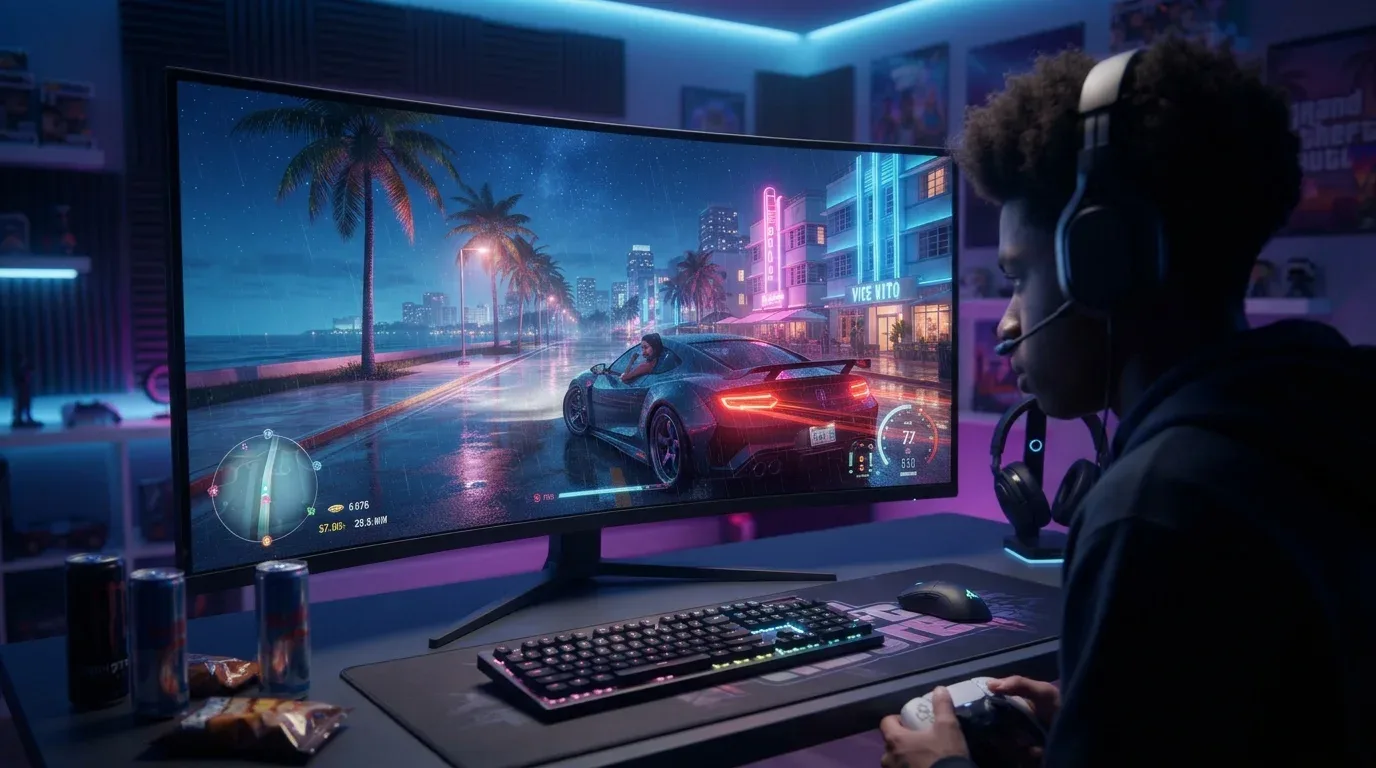
From billions of dollars in launch-day sales to arguments over virtual romance, the latest Grand Theft Auto instalment is proving that a video game can be much more than a game.
Imagine a product that sells billions of dollars’ worth of copies in a single day, gets people negotiating with their romantic partners over television time, and inspires debate about whether taking a fictional character on a date amounts to cheating.
It sounds like the plot of an elaborate Hollywood production. Except it is happening around a video game.
Meet Grand Theft Auto VI, popularly known as GTA 6, the latest instalment in one of the world’s most successful video game franchises. Released on November 19, 2026, the game has already become a major commercial and cultural talking point.
For anyone unfamiliar with the GTA universe, here is the basic idea: Players enter a fictional world, explore cities, drive cars, undertake missions and, frequently, engage in criminal adventures. Think of a combination of an action film, a virtual city and a crime drama, except you get to control much of what happens.
The first GTA appeared in 1997. Nearly three decades later, its sixth major instalment has taken the franchise to extraordinary heights.
A launch worth billions
The numbers are almost as dramatic as the game itself.
According to Rockstar Games’ parent company, Take-Two Interactive, GTA 6 generated US$3.79 billion in worldwide retail sales during its first 24 hours. The company also reported 32.5 million copies sold before launch.
The figures, announced on November 20, 2026, make it an extraordinary entertainment launch, not merely a successful video game release. Take-Two’s announcement describes it as a record across entertainment.
The game has also been associated with another extraordinary figure: An estimated US$1 billion in lost productivity for the American economy, supposedly because workers would rather play it than work.
To be sure, this estimate has attracted attention from reputable media outlets, including The Guardian and WLRN, a Florida public radio station. However, reporting on a claim is not the same as confirming it. PolitiFact’s investigation found no reliable survey or published economic study establishing either the alleged 1.5 million workers planning to take time off or the billion-dollar loss. Economists also questioned the assumptions behind the calculation.
Still, the game has certainly captured the world’s attention.
The game is set in the fictional American state of Leonida, inspired by Florida. Its best-known city is Vice City, a neon-lit metropolis reminiscent of Miami.
The fictional world is also designed to feel alive. There are crowded streets, beaches, wildlife, shops, entertainment venues and people going about their everyday business.
In fact, a Guardian feature on the making of GTA 6 describes an impressively detailed environment in which players can interact with pedestrians, overhear conversations and even identify different bird species. The preview documented 62 types of birds.
It is a virtual society where, apparently, even birdwatching has found a place between bank robberies.
When a virtual girlfriend becomes a real-life problem
Perhaps one of the strangest controversies surrounding GTA 6 has little to do with its violence or criminal activities.
It is about romance.
Jason Duval and Lucia Caminos are a couple, and players can develop their relationship through activities such as exchanging messages, going on dates and spending time together. The relationship is not entirely compulsory; players can decide how much they want to nurture it.
That has prompted an unexpected question: Can maintaining a romantic relationship with a fictional character amount to cheating on a real-life partner?
Inflection thinks this is a slippery slope. What we repeatedly give our attention and emotions to can shape our expectations, priorities and behaviour. But people will naturally draw the boundaries of their relationships differently.
The debate has been particularly lively on social media. Some women have expressed discomfort at the thought of their boyfriends spending time nurturing a virtual romance. The discussion also applies in reverse, since players can control Lucia and develop her relationship with Jason.
The Canadian Press reported on couples negotiating gaming time and even drawing up humorous agreements to protect their real-life relationships. One Toronto boyfriend, Roman Burke, sent his girlfriend, Alexandra Abad, a mock gaming contract. His terms included keeping the television free and waiting until he finished a mission before making demands on his attention.
Her counteroffer included compensation in the form of shopping and date nights. She also wanted him to put more effort into their real-life relationship than he put into his on-screen romance.
Romance, it seems, now comes with terms and conditions.
The discussion is not entirely frivolous, though. A YouGov poll of 4,114 British adults, reported by the BBC, found that six per cent would consider it cheating if their partner played a game requiring their character to maintain a romantic relationship with another character. Another 19 per cent would not consider it infidelity but would nevertheless feel uncomfortable with it.
There are also social media rumours of couples actually separating because of the game. However, no reliable statistics have established a wave of break-ups attributable to GTA 6. The controversy nonetheless raises an interesting question about emotional boundaries, virtual relationships and how much attention people devote to entertainment at the expense of their partners.
Not just a game: The artificial intelligence question
Another fascinating dimension is the technology behind the experience.
GTA 6 features sophisticated game artificial intelligence, helping control how pedestrians, police officers and other characters behave.
Police can respond to crimes using details such as a player’s appearance, clothing and vehicle. Characters react to their surroundings, while the game’s systems make the virtual world feel more dynamic.
But there is an interesting twist. Despite the growing excitement around generative artificial intelligence, Take-Two chief executive Strauss Zelnick has said that generative AI has no part in what Rockstar is building. He describes the company’s virtual environments as handcrafted, with developers creating their worlds building by building and street by street.
That does not mean the game has no AI. Rather, it is important to distinguish traditional game AI, which controls character behaviour, from generative AI, which creates new content or conversations. GamesRadar reported on Zelnick’s comments.
The distinction is significant. A game can make its characters appear remarkably intelligent without having every pedestrian powered by something resembling ChatGPT.
The adult side of the virtual paradise
For all its beautiful scenery, impressive technology and entertainment value, GTA 6 is certainly not designed for children.
Its American age classification is Mature 17+ – yes, 17, not 18 and above! The number may surprise readers accustomed to 18+ classifications, but this is the American Entertainment Software Rating Board’s (ESRB) system, not a universal age recommendation.
The official rating identifies blood and gore, intense violence, nudity, strong sexual content, strong language, mature humour and the use of drugs and alcohol.
Players engage in criminal missions involving car theft, robberies, drugs and violent confrontations.
This is not a harmless children’s adventure disguised as a driving simulator. It is an adult entertainment product, and parents should take its content classification seriously. The Entertainment Software Rating Board provides the full content assessment.
A virtual world with very real consequences
There is a bigger story behind GTA 6 than its spectacular launch figures.
The video game industry has evolved into a powerful entertainment business, competing for people’s money, time and attention alongside film, television and music.
GTA 6 illustrates that transformation rather dramatically. It has generated billions in reported first-day sales, revived conversations about gaming and relationships, and demonstrated just how sophisticated interactive entertainment has become.
Its influence is also a reminder that technology does not operate in isolation. The way people engage with virtual characters, spend money on digital entertainment and balance gaming with everyday responsibilities has consequences beyond the screen.
And perhaps that is the most interesting thing about GTA 6.
In a world where people already spend hours scrolling through social media, watching online videos and communicating through digital platforms, the boundaries between virtual entertainment and real life are becoming increasingly blurred.
GTA 6 may invite players to steal cars, rob banks and navigate a fictional criminal underworld. But its biggest real-world achievement may be much simpler: Getting millions of people to talk about what a video game means in modern society.
One thing is certain. Vice City is fictional. The money, the headlines and the relationship negotiations are very real.