
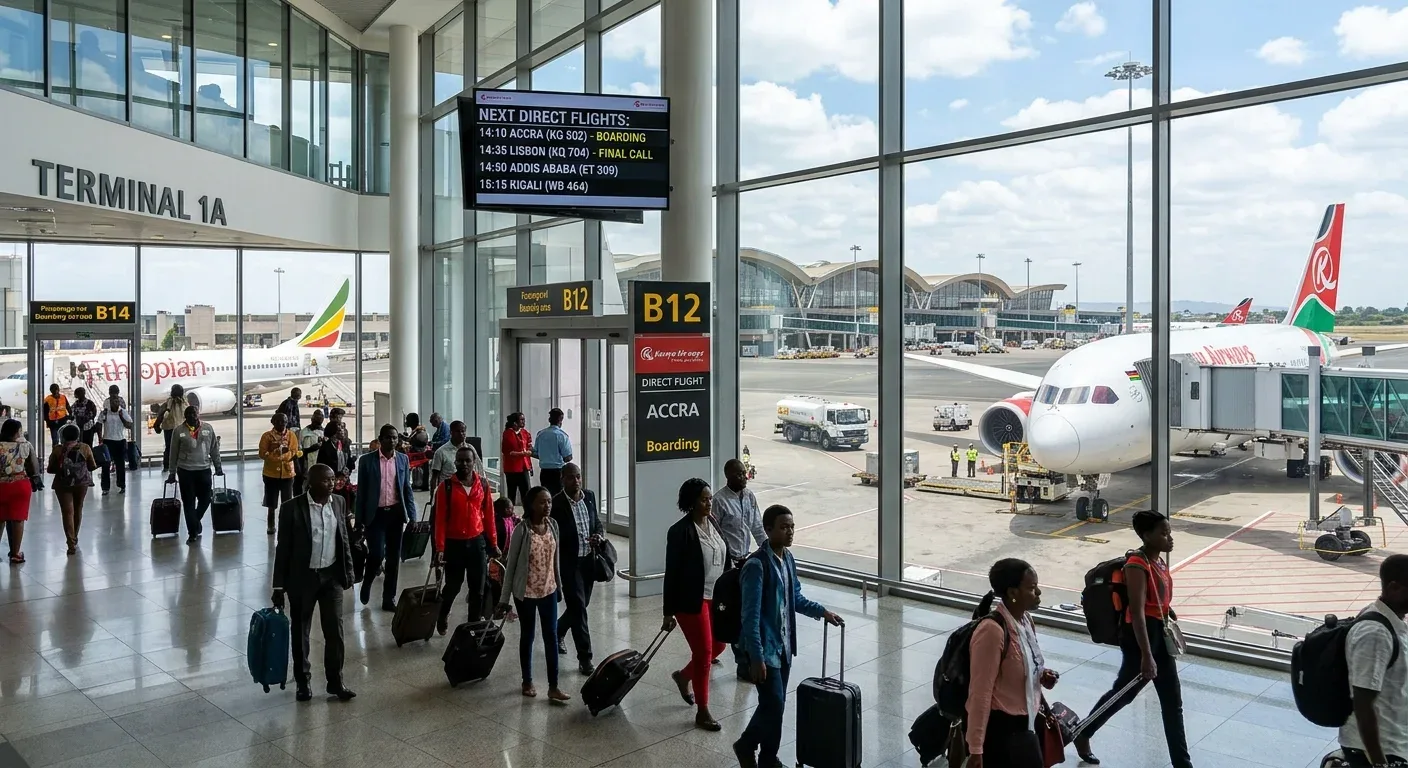
Until a few years ago, Joseph Mwangi had learnt to dread a question his clients in Accra asked whenever he arrived in Ghana: “How was your flight?”
For the Nairobi-based procurement consultant, the answer was invariably the same. There had been no flight, not really. Just a long layover in Kigali, a longer one in Addis Ababa or a maddening connection through Johannesburg that added an entire day to a journey that, on a map, looked like a relatively short hop across the continent.
Mwangi, 54, did the math. A return ticket from Nairobi to Accra, booked three weeks in advance, typically cost him between $850 and $1,200. The journey took anywhere from 14 to 22 hours, depending on the connection.
A colleague travelling from London to Accra on the same dates paid roughly $600 and spent six hours in the air. The Londoner arrived fresher, sooner and at a lower cost in a city geographically closer to Nairobi than London.
“Sometimes I used to sit in Kigali airport and I just laugh,” Mwangi said, nursing a coffee in a Nairobi hotel lobby before another trip. “I am an African man, travelling between two African capitals, and I am waiting in a third country. My money is going to airlines that see Africa as a stopover. My time is going to connections that should not exist. And my continent cannot give me a direct flight.”
This is the central absurdity of African aviation: A paradox that has persisted for decades despite the continent’s growing population, expanding middle class and urgent need for economic integration.
Africa is home to nearly 20 per cent of the world’s population but accounts for less than 2 per cent of global air traffic. Intra-African connectivity is so poor that, on some routes, travelling from Lagos to Nairobi via Istanbul can be cheaper and faster than flying directly between African cities.
The continent’s skies, in effect, remain colonised. Not by European powers flying their flags, but by European and Middle Eastern airlines capturing the profits.
The reasons are rooted in history, protectionism and chronic underinvestment. The consequences are reflected in lost trade, stunted integration and the daily indignity of African travellers having to leave their continent to move within it.
The solutions, chief among them a long-promised single African air market and the prospect of a genuinely pan-African airline, remain caught between political rhetoric and commercial reality.
The prohibitive cost of flying African
“The first thing to understand about African aviation is that it is expensive to operate an airline here. Not marginally expensive. Structurally, painfully, almost prohibitively expensive,” says Captain Mwenda Mabura, a former Kenya Airways pilot and veteran African aviator and industry analyst.
An industry executive affiliated with the Kenya Civil Aviation Authority describes what he calls a “30 per cent Africa premium”: A structural surcharge that makes doing the same thing in Africa cost roughly a third more than in developed markets.
“Spare parts that can be sourced in Miami or Dubai within an hour must be imported into most African countries, incurring shipping costs, customs delays, and aircraft grounded for days. Fuel, the largest single operating cost for any airline, is a particular burden,” says the industry insider, who heads a government aviation body and spoke on condition of anonymity because he was not authorised to comment publicly.
Africa holds between 7 and 8 per cent of global crude oil reserves but imports most of its refined jet fuel, spending an estimated $60 billion to $90 billion annually on petroleum products. Seventy per cent of those imports transit the Strait of Hormuz, exposing African airlines to geopolitical shocks far beyond their control.
Then there is the fleet problem.
“Most global airlines lease their aircraft. Most African airlines own theirs, often older models that burn more fuel and require more maintenance, which in turn often means flying them back to Europe or the Middle East for servicing because Africa lacks the capacity,” says Captain Mabura.
He adds that the entire continent, home to 1.4 billion people, operates a commercial fleet of fewer than 1,000 aircraft.
“Even if we charge exactly the same airfare as our non-African airline counterparts, we still end up in the red,” says Aaron Munetsi, chief executive of the Airlines Association of Southern Africa.
But operating costs account for only half the problem. The other half is regulation.
A single African sky, still out of reach
Africa’s aviation market remains fragmented by a patchwork of bilateral air service agreements negotiated country by country. Many were designed to protect state-owned carriers from competition rather than make it easier for passengers and airlines to move across borders.
The Yamoussoukro Decision, a landmark 1999 agreement intended to liberalise African skies, was supposed to dismantle this regulatory maze. Signed by 44 countries and made binding in 2002, it remains largely unimplemented nearly a quarter of a century later.
“Seventy per cent of Africans alive today have spent their entire lives waiting for their leaders to implement something that was decided unanimously by every member of the African Union nearly 40 years ago,” says Captain Mabura, referring to the original 1988 Yamoussoukro Declaration.
Its more recent successor, the Single African Air Transport Market (SAATM), launched in 2018 with considerable fanfare, has fared only marginally better.
Thirty-eight states have signed up, but implementation remains uneven. The Continental Study on the Benefits of SAATM found that full liberalisation could generate nearly 600,000 additional jobs, contribute $4 billion to annual GDP, reduce average fares by 26.4 per cent and increase flight frequencies by 27 per cent.
Yet a 2019 baseline assessment found that only 19 per cent of African country pairs had significant direct air services, while just 35 per cent of existing routes operated daily or more frequently.
The gap between signed agreements and actual aircraft in the sky is captured by what the International Civil Aviation Organisation (ICAO) describes as the distinction between “formal market access and commercially usable market access”.
A country can grant fifth-freedom rights, allowing an airline from one country to carry passengers between two other countries, on paper. But if approvals take months, airport slots never materialise and visa restrictions make connections impractical, those rights exist largely in a filing cabinet in Addis Ababa.
The result is a continent riddled with missing links.
The missing links in Africa’s aviation network
Embraer’s 2026 Connecting Africa report identified 55 intra-African city pairs that still lack direct scheduled services, up from 45 the previous year.
Some of these gaps are merely inconvenient. Others are economically self-defeating.
Consider Cape Town and Lagos, arguably one of the continent’s most important unserved corridors. An estimated 70 passengers travel between the two cities each day in each direction, yet no airline operates a non-stop service.
Travellers must connect through Johannesburg, Addis Ababa, Nairobi or even Doha, Qatar, adding hours and expense to a route that should be central to intra-African trade.
South Africa and Nigeria are the continent’s two largest economies. Yet their commercial capitals cannot communicate directly by air.
The pattern is repeated across the continent.
Abuja to Nairobi, connecting Nigeria’s capital with East Africa’s principal aviation hub, has no direct service. Passengers must connect through Addis Ababa or Kigali.
Dakar to Libreville, linking West and Central Africa, requires a detour through Lomé or Abidjan. Bamako to Libreville involves multiple transfers.
Maputo to Nairobi, following Kenya Airways’ suspension of the route in August 2025, now requires passengers to connect through Johannesburg or Addis Ababa.
Even Durban to Mauritius, a relatively short journey across the Indian Ocean, lacks a direct service, forcing travellers to route through Johannesburg.
These are not remote settlements or marginal destinations. They are national capitals, commercial centres and tourism gateways.
Their disconnection is not a geographical accident. It is the consequence of political and regulatory choices.
“The findings confirm that Africa’s connectivity gap is not narrowing,” the Embraer report concluded.
The national carrier obsession
At the heart of the dysfunction is a political fixation on the national airline as a symbol of sovereignty.
Governments continue to pour money into loss-making state carriers, shield them from competition and insist on operating wide-body aircraft to London, Paris and Dubai, sometimes with half-empty cabins.
The flag on the aircraft, it seems, matters more than the balance sheet.
“Especially national carriers tend to define success as running half-empty, wide-body planes to London, Paris, and Dubai, as long as they are painted in the national colours,” Munetsi says.
The numbers are troubling.
Africa has 52 national carriers, according to the Airlines Association of Southern Africa, but only a fraction are operational. Ethiopian Airlines is the only carrier consistently reporting a profit.
Kenya Airways, despite its strategic partnership with KLM, has required repeated government bailouts.
Uganda Airlines, revived in 2019, lost nearly $80 million in 2024 alone and has faced aircraft groundings and passenger strandings.
South African Airways spent years under business rescue. Nigeria Airways collapsed in 2003 and was never replaced.
Air Afrique, the great pan-African experiment, went bankrupt in 2002 with debts of $464 million. Its 11 state owners had proved unable to agree on management or strategy.
This historical pattern is no accident.
Early national carriers were designed less to connect Africans with one another than to link African commodities and elites to European metropolitan centres.
Air Afrique, for all its pan-African rhetoric, was structured around Paris. The routes that generate the most revenue, and continue to sustain many airlines, are those linking African capitals with Europe, the Middle East and China.
These are the lucrative routes that keep airlines afloat, or at least slow their financial bleeding. Intra-African services, with thinner passenger demand and greater regulatory friction, are often an afterthought.
“Countries that don’t have their own national carrier still want to hold on to this dream,” Munetsi says. “Governments exist to create an enabling environment and not to actually micromanage the minutiae of an industry.”
The economic price of disconnection
The cost of this dysfunction is not abstract. It is measured in missed business opportunities, unrealised trade potential and the gradual erosion of pan-African solidarity.
Air transport contributes $75 billion directly to African GDP and supports an estimated 8.1 million jobs. Each aviation job sustains a further 22 jobs across the wider economy, while every dollar of value created directly by the sector generates another $5.30 elsewhere on the continent.
Yet these benefits are concentrated in the hubs that function: Addis Ababa, Johannesburg, Nairobi and Casablanca. Vast areas of the continent remain effectively disconnected.
The African Continental Free Trade Area (AfCFTA), the world’s largest free trade area by number of participating countries, depends on connectivity that does not yet exist.
Goods that could move directly between African markets are often routed through Dubai or Europe.
A Tunisian exporter trying to reach a buyer in Nairobi faces the same problem as Mwangi. The absence of direct air cargo links forces goods through hubs outside the continent, adding costs and delays to transactions that the free trade area was supposed to make seamless.
The human cost extends well beyond business.
Families are separated by routes that make a weekend visit impractical. A South African entrepreneur cannot simply travel to Lagos for a Monday meeting without potentially losing two days to connections.
A Mozambican student travelling to Nairobi must route through Johannesburg or Addis Ababa, adding expense and exhaustion to what should be a relatively short journey.
Tourists who might otherwise explore several African countries in one trip often settle for a single destination because regional connections are too expensive or exhausting.
The larger ambition of a pan-African identity, of Africans knowing, trading with and learning from one another, is undermined by a simple reality: Getting from one part of Africa to another can be harder than leaving the continent altogether.
And the money flows outwards.
Foreign airlines provide services on a third of intra-African routes through hubs outside the continent and serve eight of the ten most lucrative African routes.
Emirates, Qatar Airways, Turkish Airlines, Air France, British Airways and KLM are among the carriers that benefit from Africa’s fragmented aviation market.
Every Kenyan businessman routed through Dubai becomes a customer supporting the Gulf aviation economy. Every Ghanaian student travelling to Nairobi via Amsterdam contributes to the Dutch aviation sector. Every South African executive connecting through Doha to reach Lagos helps sustain Qatari aviation infrastructure.
The hub-and-spoke colonialism of the 21st century is not enforced by gunboats. It is imposed through timetables, tariffs and the absence of alternatives.
The elusive dream of a pan-African airline
The idea of a single, integrated African airline is almost as old as independence itself.
Air Afrique was its first major expression: A multinational carrier owned by 11 West African states and built around the ambition of pan-African cooperation.
It collapsed under political interference, mismanagement and the inability of its owners to subordinate national interests to continental ones.
The dream resurfaced in different forms over subsequent decades, through alliances, code-sharing arrangements and cooperative frameworks.
In 2021, Kenya Airways and South African Airways signed a strategic partnership framework intended to lay the groundwork for a broader pan-African grouping.
The initiative stalled as both carriers faced balance-sheet pressures, and South African Airways formally withdrew in early 2025.
But the logic behind the partnership has only become more compelling.
Outgoing Kenya Airways chief executive George Kamal, who also chairs the African Airlines Association, made an impassioned case for integration.
“If not now, then when? If not us, then who will do it?” he asked. “Why do African airlines compete aggressively against each other on thin routes, while foreign carriers consolidate traffic flows across our continent with stronger partnerships?”
Kamal’s proposal is for a pan-African alliance rather than a single merged airline. It would involve coordinated scheduling, aligned hubs, and integrated cargo and maintenance operations.
It is a more modest vision than the old Air Afrique model and perhaps a more realistic one.
But the obstacles remain formidable.
African governments have shown little willingness to surrender control of their national carriers, even when those airlines are consistently loss-making.
SAATM, designed precisely to facilitate this kind of integration, remains under-implemented. Meanwhile, the financial weakness of most African airlines makes them unattractive partners for the deep cooperation required to transform the market.
Yet the potential is substantial.
The Continental Study on SAATM’s benefits estimated that full liberalisation could generate nearly 600,000 jobs and add $4 billion to annual GDP.
The African Civil Aviation Commission reports that implementation so far has generated more than three million additional passengers, approximately 8,200 direct and indirect jobs, and $2.8 billion in facilitated trade. Thirty-eight states are participating, with 24 involved in the Pilot Implementation Project.
These are significant gains, but they represent only a fraction of what a genuinely open African aviation market could deliver.
A successful pan-African carrier, whether a single airline or a deeply integrated alliance, would do more than transport passengers.
It could pool risk across the continent, allowing smaller countries to benefit from aviation without shouldering the full cost of maintaining national airlines.
It could negotiate fuel contracts, aircraft leases and maintenance agreements at scale, helping to erode the 30 per cent cost premium.
It could prioritise underserved routes that no individual national carrier can sustain alone: The Cape Towns to Lagos, the Abujas to Nairobis and the Dakars to Librevilles.
It would give African businesses greater incentive to trade with one another, African tourists more reason to explore their own continent, and African governments a practical instrument of integration rather than another symbolic flag carrier.
Most importantly, it would demonstrate that the present arrangement, in which a Kenyan cannot fly directly to Ghana and a South African cannot fly directly to Nigeria, is not a geographical inevitability. It is a political choice.
Liberalisation before consolidation?
Not everyone believes the pan-African airline dream is worth pursuing.
Critics argue that Air Afrique failed precisely because multinational government ownership is a recipe for paralysis.
They contend that the priority should not be creating another continental airline but liberalising the market so that private carriers, African and foreign alike, can compete wherever demand exists.
“The reality is that a number of African leaders are simply jokers about this issue,” Captain Mabura says of SAATM implementation. “They’re paying it lip service, but they’re not taking the concrete steps needed.”
The sceptics have a compelling example on their side: Ethiopian Airlines.
The continent’s most successful airline is state-owned but operates with a degree of commercial discipline and strategic clarity that many of its competitors lack.
Ethiopian has developed Addis Ababa into a hub that rivals Dubai and Istanbul for African connectivity. It has done so by resisting the protectionist instincts that have crippled other national carriers.
It serves more African destinations than any other airline on the continent and remains profitable.
If Ethiopian can succeed, the argument goes, the problem is not the model but the management.
Yet even Ethiopian cannot resolve Africa’s connectivity deficit on its own.
It has its own commercial interests, its own hub to fill and its own routes to protect. A genuinely integrated African aviation market would require more than one successful carrier.
It would require a system in which multiple airlines can compete and cooperate across borders without the regulatory obstacles that currently turn every new route into a diplomatic negotiation.
What needs to change?
The technical solutions are relatively well understood.
They include full implementation of SAATM, including meaningful fifth-freedom rights and mutual recognition of pilot licences and aircraft maintenance certifications.
Bilateral air service agreements must be aligned with the principles of the Yamoussoukro Decision. Governments must also resolve the problem of blocked funds, which has seen airline revenues trapped in countries such as Mozambique and Nigeria.
Nigeria, for example, cleared $850 million in blocked airline funds only after international carriers began withdrawing services.
There is also an urgent need to invest in fuel infrastructure and aircraft maintenance capacity.
Above all, African leaders must make a political commitment to treating aviation as a continental public good rather than a national prestige project.
The harder question is whether such a commitment exists.
The African Union’s Agenda 2063 envisions an integrated continent, with SAATM designated as one of its flagship initiatives.
But the gap between ambition and implementation has been the defining feature of African aviation for four decades.
Ministers meet. Declarations are signed. Road maps are published.
The planes do not come.
Sixty years later, the map still does not work
Mwangi, the Nairobi-based consultant, has stopped expecting things to change.
He has learnt to book his Accra trips through Kigali or Addis Ababa, accept the layovers and budget for the additional expense.
He has also learnt to answer his Ghanaian clients’ familiar question about his flight with a shrug and a joke.
But he has not stopped noticing the absurdity.
“My grandfather flew to London on BOAC in 1965,” he said. “He couldn’t fly to Accra either. That’s the thing. It’s been sixty years, and the map still doesn’t work.”
The skies above Africa are open in theory.
On the ground, the paperwork is still being filed.
Additional reporting and data analysis from IATA, the African Development Bank, the African Union Commission and ICAO documents.